TrialAI · Clinical Research
Could an LLM help design a clinical trial without breaking the science?
A proof-of-concept platform for AI-assisted trial protocols, designed with the researchers who write them. Built in 2023, before this was the obvious thing to build.
The bet: AI belongs in trial design, but only where rigor survives it
TrialAI explored how large language models could support clinical trial researchers in synthesizing, comparing, and designing more efficient protocols. The constraint that shaped everything: assist early design tasks without compromising scientific rigor or regulatory compliance.
The user is a scientist with no time and no tolerance for error
Actions & Motivations
- Designs and implements clinical trials with multidisciplinary teams.
- Ensures compliance with ethical and regulatory standards.
- Driven to improve patient outcomes through rigorous, efficient science.
- Seeks tools that enhance collaboration and reduce cognitive load.
Pains
- Balancing comprehensive criteria design with time pressure.
- Managing heavy workloads across multiple trials.
- Maintaining clear communication in distributed teams.
Additional Research Persona Insights
We also interviewed data analysts and medical scientists from the pharmaceutical and life sciences sectors. They shared complementary challenges around data interpretation, NLP application, and clinical data extraction.
- Goals: Accelerate drug discovery through improved data analysis and automation.
- Skills: Medical advancements, data analytics, and NLP for clinical datasets.
- Needs: Reliable biomedical NLP tools and AI systems to extract insights from EHRs.
- Pain Points: Limited time for deep analysis, rapidly evolving technologies, and uncertain research funding landscapes.
The architecture keeps the registry data honest and the AI on a leash
The architecture behind TrialAI connects backend clinical trial registries with an AI-assisted front-end interface. Structured data from sources like Citeline and ClinicalTrials.gov flows into a generative layer that powers intelligent search, summarization, and inclusion/exclusion criteria generation.
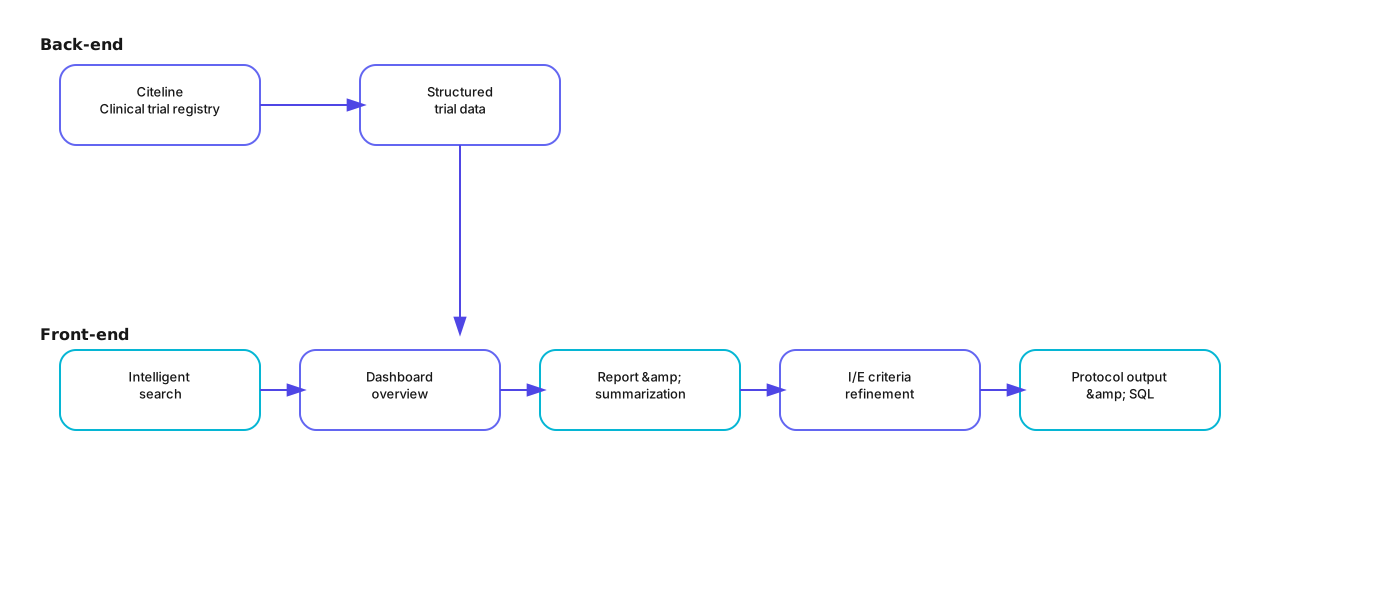
Data flow from backend registries to AI-powered front-end workflows
Researchers talked to it like a colleague, and it held up
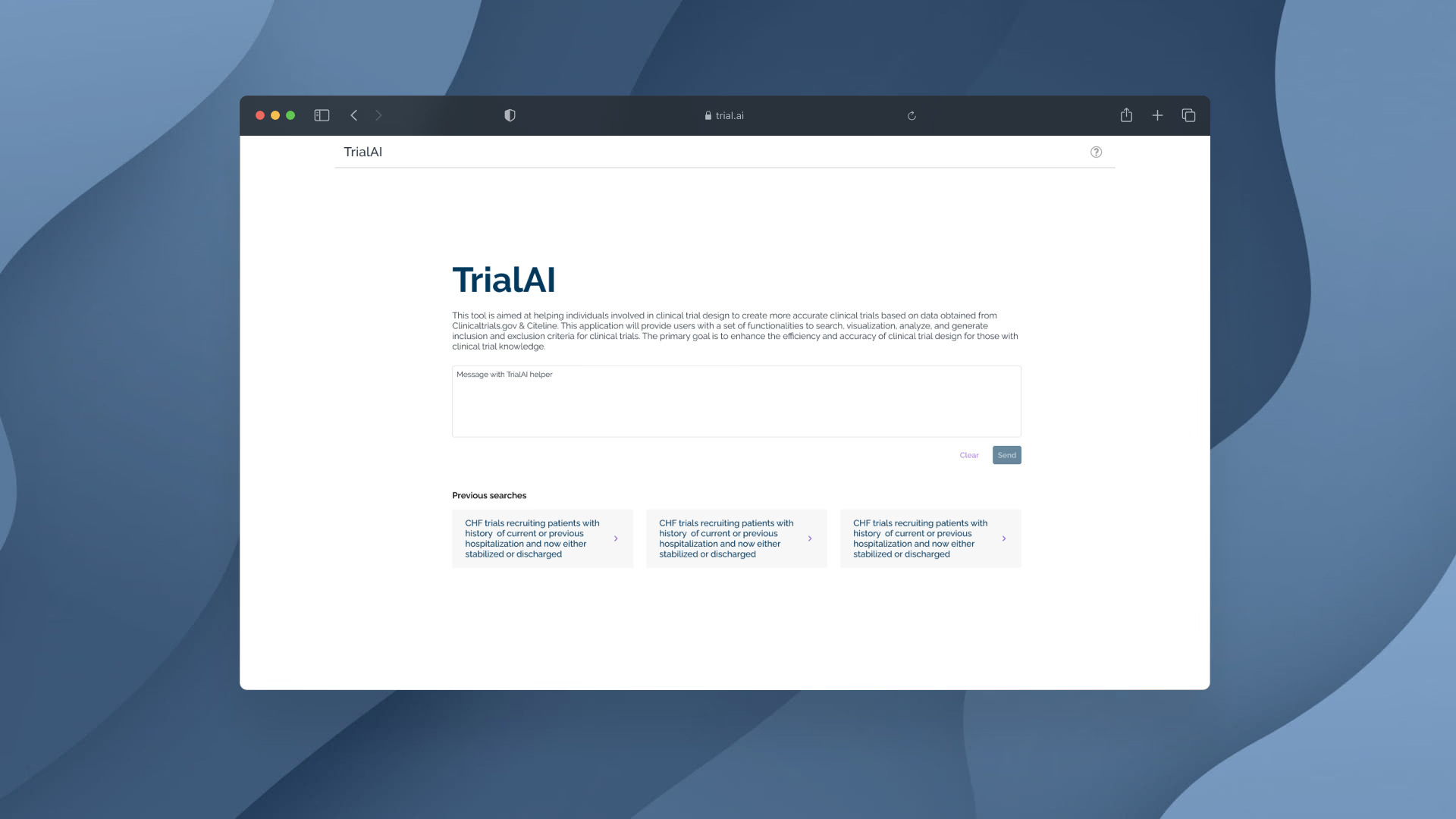
The high-fidelity prototype illustrated how clinical researchers could interact conversationally with TrialAI to query and refine trial parameters. The chat interface let researchers move from data exploration to concrete protocol decisions without switching tools.
What it proved
Through this research and prototyping effort, TrialAI demonstrated how LLMs can reduce friction in trial design: literature review, protocol drafting, and eligibility criteria generation. The findings inform a roadmap toward ethical, explainable AI integration in biomedical research tools.